
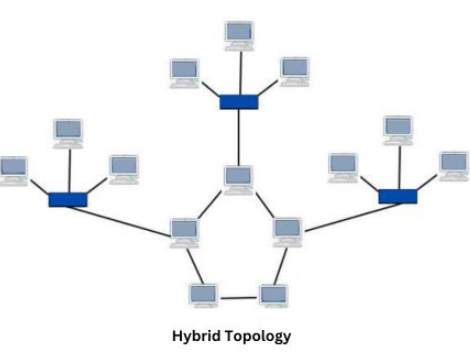
Understanding common LAN topologies is crucial for anyone involved in networking, whether for personal setups or organizational infrastructure. Each topology has its own advantages and disadvantages, influencing factors such as performance, scalability, and cost-effectiveness. Knowing these can help you make informed decisions when designing or troubleshooting network systems.
Bus Topology
Bus topology is one of the simplest network configurations, where all devices connect to a single central cable, known as the bus. This topology is cost-effective and easy to set up, making it ideal for small networks. However, the main drawback is that if the central cable fails, the entire network becomes inoperative, leading to potential downtime and maintenance challenges. Additionally, performance can degrade as more devices are added, given that all data packets travel along the same cable.
Star Topology
In star topology, all devices are connected to a central hub or switch. This design enhances reliability, as failure in one link does not affect others; only the device connected to that particular link is impacted. Additionally, troubleshooting is more straightforward since all connections funnel through one point. Its main disadvantage is the dependency on the central hub—if it fails, the entire network ceases to function. Nevertheless, star topology is favored in modern networks due to its scalability and ease of management.
Ring Topology
Ring topology connects devices in a circular arrangement, where each device has exactly two neighbors for data to travel in one direction. This structured approach can lead to predictable performance and easier fault isolation. However, like bus topology, a failure in any single device can disrupt the entire network. To mitigate this, many organizations employ dual ring setups to provide redundancy, allowing for continuous operation even if one path fails. While it offers specific advantages, it is less common in contemporary networks compared to star topology.
In conclusion, understanding these common LAN topologies equips you with the knowledge to select the right configuration for your networking needs. Each topology has unique strengths and weaknesses, making it essential to assess your specific requirements. Take the next step in your networking journey by exploring more about these topologies and their applications!